Build muscle
How to Get Big Arms at Home with ChatGPT (Free Prompts + Dumbbell Workout)
Ahh, big arms. The holy grail of weightlifting.
Flexing for crushes, changing spare tires, opening pickle jars, carrying a 30-pound kid mid-tantrum out of the grocery store. There are many great reasons to grow big arms, and I love every single one of them, because big arms rule.
And the good news? You don’t need a gym. You can build them at home with a pair of dumbbells and the AI app that’s already on your phone.
Just want the prompts? Jump to the free ChatGPT prompts.
But what exactly counts as an arm? Dumb question? Maybe. But your arm is made up of several different muscles, and if you want the right results, you need to target all of them.
What makes a big arm?
A big arm has developed biceps, triceps, shoulders and forearms. That’s four muscle groups right there, and they can be broken down even further. Let’s start with the moneymaker: biceps.
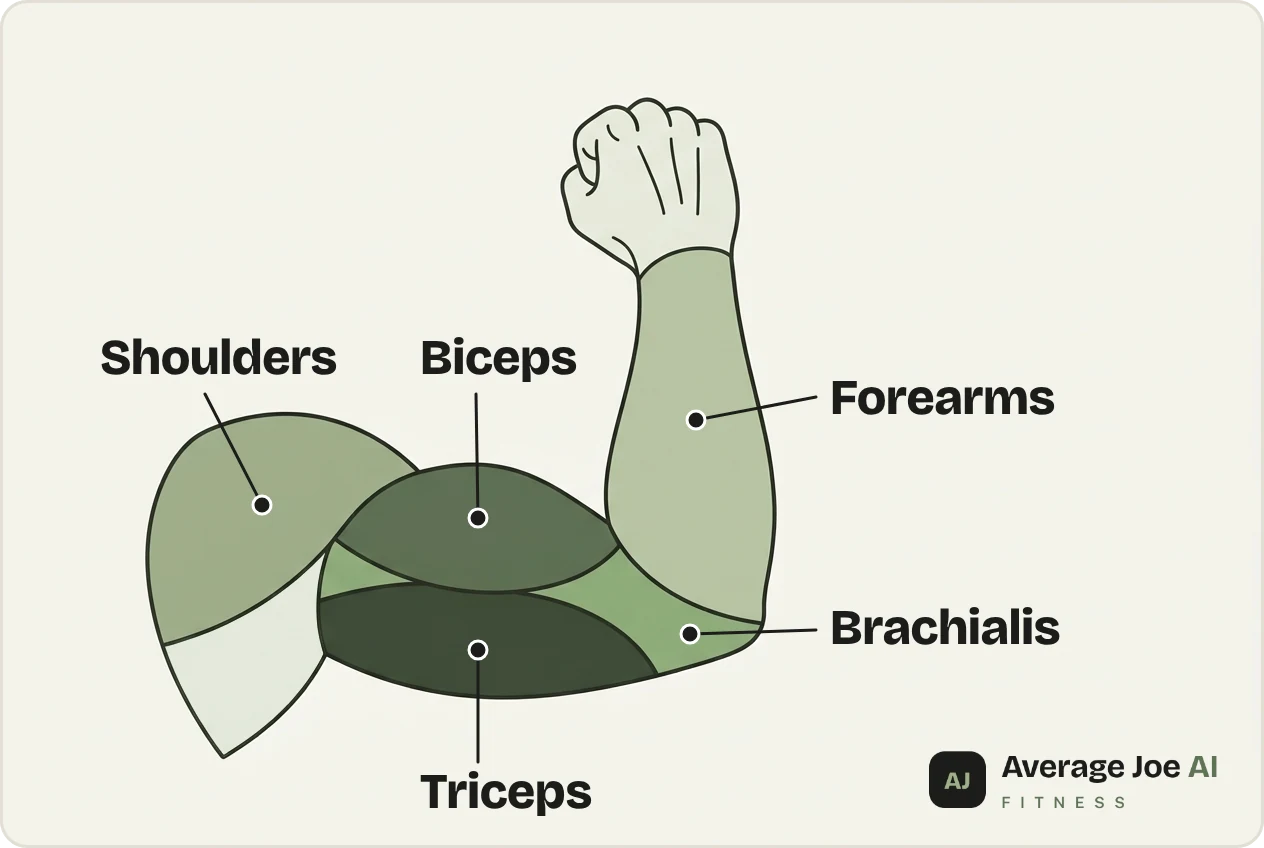
Biceps
Your biceps has two heads. That’s what the “bi” means.
- Long head: the outer side of your arm. It gives you that peak when you flex. Curls with your arms behind your body, like incline curls, stretch it the most.
- Short head: the inner side. It adds thickness. Curls with your arms out in front of you, like concentration curls, hit it hard.
There’s also a muscle underneath your biceps called the brachialis. You can’t see much of it, but when it grows, it pushes your biceps up and makes your whole arm look thicker. Hammer curls are its best friend.
Want to go deeper on biceps? Here are 16 ChatGPT prompts for bigger biceps.
Triceps
Here’s the thing most people miss: your triceps make up more of your upper arm than your biceps do. If you want big arms, this is where the size is. Triceps have three heads:
- Long head: the biggest one, on the back of your arm. It’s the only head that crosses your shoulder, so overhead extensions train it best.
- Lateral head: the outside of your arm. It’s what makes the horseshoe shape.
- Medial head: tucked underneath the other two. It works in pretty much every pressing move.
Want to go deeper on triceps? Here are 15 ChatGPT prompts for bigger triceps.
Shoulders
Your shoulder muscles are called delts (short for deltoids), and they have three heads too:
- Front delts: they work in any pressing move. If you do push-ups, they’re probably getting plenty already.
- Side delts: they make your shoulders look wide and capped. Lateral raises are the go-to.
- Rear delts: the back of your shoulder, and the most neglected. Rear delt flys fix that.
Want your AI to build your shoulder plan? Here are my ChatGPT prompts for big shoulders.
Forearms
- Flexors: the palm side of your forearm. Wrist curls train them.
- Extensors: the back side. Reverse wrist curls train them.
- Brachioradialis: the big one near your elbow. Hammer curls hit it, along with your brachialis.
Bonus: just holding heavy dumbbells trains your grip, so your forearms get work every time you lift.
Why is it hard to grow big arms?
Well, that’s a lot of different muscles. You may find you’ve only been targeting a few of them (ahem, biceps), and the others are getting neglected, so you’re not getting the full arm look.
There’s genetics, too. I personally have long arms, which is a blessing and a curse. A blessing because I can reach stuff on the high shelf over the dryer for my wife, and she can pinch my butt while I do it. A curse because it takes forever to make long arms look big.
Then there’s frequency. How often are you actually training your arms? Just once a week? That’s not really going to do it. Arm training needs to be targeted, and it needs to happen more than once a week.
Joe’s take: I’ve always struggled with biceps, even at high frequencies. I did standing curls with 20 lb dumbbells until my face turned blue, and my biceps never even got sore. Then I switched to incline curls, dropped all the way down to 12 lbs, and suddenly I was sore, burning and finally growing. At home, standing curls alone are a road to nowhere fast, unless you’re willing to spend a small fortune on heavier dumbbells just for that one exercise.
The compound exercise trap
Some people think they can build big arms with just pull-ups and push-ups. And hey, that’s cool. You’re working your upper body. Compound movements (exercises that work a bunch of muscles at once) are a great way for beginners to get fit fast.
But eventually, you’re going to need to get targeted. So now’s a good time to branch out from a generic blog post, pull out your phone, and consult your free personal trainer. Meaning: open up ChatGPT, Claude or Gemini.
How to use ChatGPT, Claude or Gemini to grow big arms
Tell your AI your current routine. Tell it about your genetics. Tell it how much time you have, and what you think is lagging. It’ll build you a routine you can actually stick to. And consistency is always king when working out.
Copy this, fill in the brackets, and send it:
I want bigger arms, and I train at home with dumbbells [AND AN ADJUSTABLE BENCH, IF YOU HAVE ONE].
Here’s my current routine: [WHAT YOU DO NOW]. About my build: [E.G., LONG ARMS, SLOW TO GAIN MUSCLE]. I can train [DAYS] days a week for about [MINUTES] minutes. The part of my arms I think is lagging is [BICEPS / TRICEPS / SHOULDERS / FOREARMS].
Build me a routine that hits biceps, triceps, shoulders and forearms, trains arms at least twice a week, and fits my schedule. Tell me how to add weight or reps each week. Ask me any questions you need before you start.
Then, after every workout, tell it how it went. It’ll adjust as you go:
Example chat
Done with today’s arms. Hammer curls felt easy. Overhead extensions were brutal, couldn’t finish the last set.
Good info. Let’s go up 2.5 lbs on hammer curls next time. Keep the overhead extensions at the same weight, and move them to the start of your workout while you’re fresh. Your triceps have the most room to grow.
And every couple of weeks, check in with this:
Here’s how my last two weeks of arm training went: [WHAT YOU DID, WHAT FELT EASY, WHAT FELT HARD]. Am I making progress? What should I change for the next two weeks?
Want more? Here are 30 ChatGPT prompts for big arms, from your first routine to a stubborn plateau.
What result did you get? Pretty dope, right? Want a full routine, plus how to set up your AI to coach your food and sleep too? Grab my free playbook.
Build big arms at home with just dumbbells: the exercises
Not ready for the playbook? Just hit these exercises at home. If you need to target certain areas, dial those up more often. Remember, frequency is really important. Most people don't train their arms enough.
| Exercise | Sets | Reps | Muscle |
|---|---|---|---|
| Dumbbell curl | 3 | 8–12 | Biceps |
| Incline curl (bench) | 3 | 10–12 | Biceps, long head |
| Hammer curl | 3 | 10–12 | Brachialis + forearms |
| Overhead triceps extension | 3 | 10–12 | Triceps, long head |
| Skull crusher (bench) | 3 | 8–12 | Triceps |
| Lateral raise | 3 | 12–15 | Side delts |
| Rear delt fly | 3 | 12–15 | Rear delts |
| Wrist curl | 2 | 15–20 | Forearms |
Split these across two or three workouts a week, or ask your AI to split them up for you. And those rep ranges only work if you pick the right weight. Which brings us to the big question.
How heavy should your dumbbells be?
Heavy enough that you're training close to failure, meaning you couldn't squeeze out many more reps with good form.
Pick a weight where it's a real fight to hit 12 reps on your first set. By your third set, you're only getting 8 or so. That's exactly right. Stick with that weight until you can hit 12 on every set, then go heavier.
This is called progressive overload, and you just can't build big arms without it.
The best play for home: adjustable dumbbells
So what's the best way to keep going heavier at home? Buy adjustable dumbbells. I like the metal kind where you screw on different plates. They're only about $50, and they go up to 20 lbs. That's plenty of weight to get pretty darn big arms if you're dedicated and your form is rock solid.
And if you can swing it, get an adjustable bench too. Fun fact: one costs about as much as a single pair of 25 lb dumbbells. For the same money, you unlock incline curls, skull crushers and a bunch of other moves, which means a lot more progressive overload potential.
Joe tip: not sure where to start? Tell your AI which weights you have, and ask it what to start with for each exercise.
Tips for growing big arms at home
- Train frequently. Yes, I know, I keep saying it, because I mean it. Muscle is built while you rest, but nobody ever got big arms by not training arms.
- Don't over-rely on compound movements. Push-ups and pull-ups are a great base. Big arms need targeted work on top.
- Lower the weight slowly. Take two or three seconds on the way down. That part of the rep counts too.
- Focus on form before you add weight. Going too heavy can cause an injury, and then you'll never get big arms.
- Get an adjustable bench. You don't need one at first, but with an adjustable bench you can do incline curls, my personal favorite, and unlock all sorts of other movements.
- Eat enough protein, and enough calories. Your muscles need material to grow. Not sure how much? Ask your AI to work out a target for your size and goal.
- Get enough sleep. Sleep > rest days.
Quick questions
Can you get big arms with just dumbbells?
Yes. Your muscles don't know whether the weight came from a gym. What matters is training them often and adding weight or reps over time.
How often should you train arms?
Two or three times a week works for most people. Once a week usually isn't enough.
How long does it take to get bigger arms?
Give it a couple of months of steady training. Your strength goes up first, and the size catches up after.
Thanks for reading. Download the guide, and go get those big arms.
— Joe
New posts, straight to your inbox.
Fresh prompts, workouts and tips from Joe whenever a new post goes up.
Something went wrong. Please try again, or email us directly.
You're in! Check your inbox.
Unsubscribe anytime. Privacy policy
Keep reading